Takeoff and Landing Performance Assessment (TALPA) Aviation Rulemaking Committee (ARC) - Following the runway overrun at Chicago Midway in December 2005, the FAA chartered the TALPA ARC to improve the safety of operations on wet and contaminated runways. TALPA is the colloqial term for the new system.
Runway Condition Code (RCC or RwyCC) - A number value on a scale from 0 to 6 of the section of a runways braking action. RCCs are formatted in sets of three for the approach end, middle, and departure thirds of a runway.
Runway Condition Assessment Matrix (RCAM) - An assessment matrix which converts observations of a section of runway into an RCC.
Global Reporting Format (GRF) - GRF is what the rest of the world (ICAO) calls TALPA.
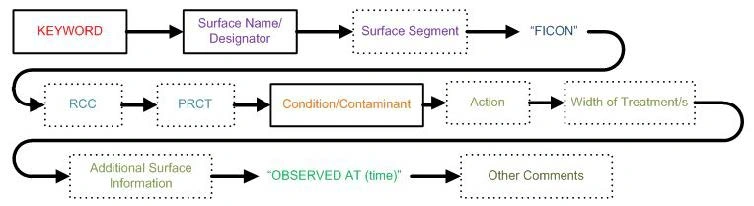
The official guidance on writing FICON NOTAMs can be found in FAA Order 7930.2 Section 5-1-4. They are constructed via the following format:
RWY 33 FICON 4/4/4 100 PRCT COMPACTED SN PLOWED 100FT WID 24IN BERMS OBSERVED AT 1612112319. 1612112319-1612122319
While most of this NOTAM is self explanatory, the RCC codes were determined through analysis.
AC 150/5200-30 defines the process for determining RCC codes.
Step 1: 25%? - Does the contaminant cover more than 25% of the runway? RCCs are only generated with coverage greater than 25%.
Consider the following NOTAM:
RWY 36 FICON 10 PRCT ICEIf RCCs aren't listed, then it's 6/6/6. Is a FICON of 6/6/6 with ICE a contradiction? "10 PRCT" actually means 10% or less. So this runway should be effectively free of contaminants.
But let's continue as if the contaminant covers more than 25% of the runway.
Step 2: The RCAM - Assess contaminant type, depth, and temperature using the RCAM below.
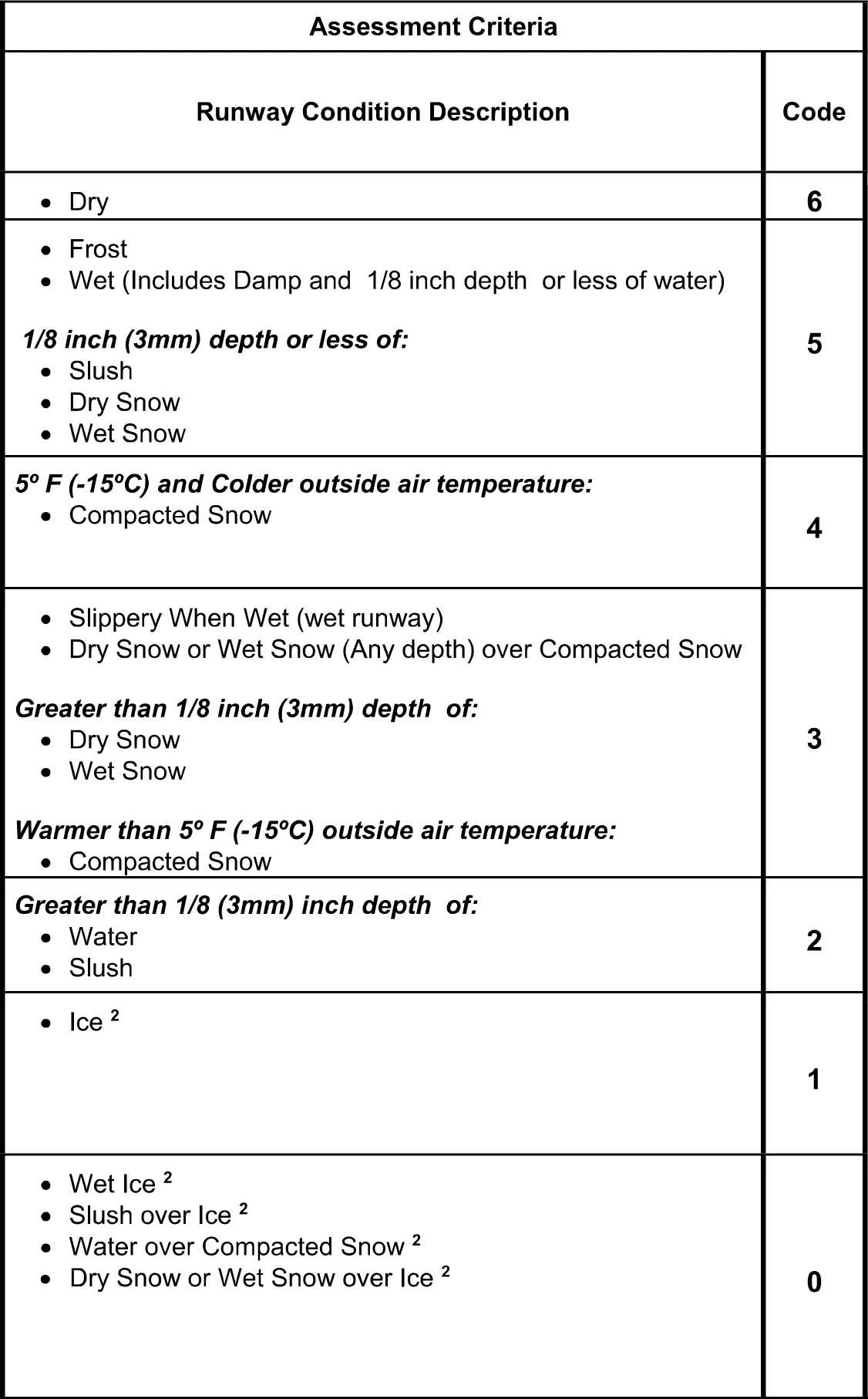
Step 3: Upgrades and Downgrades - The individual who drives the airport ops pickup onto the runway and performs the assessment might downgrade the RCC code. Downgrades can be decided using a friction measurement device or just personal judgement. In some restricted cases, upgrading the code is permitted.
RCCs of 0? - The NOTAM system does not allow reporting of RCCs of zero, as means to force the operator to close the runway. (NOTAMs are created by clicking through web templates and drop down menus.)
SLIPPERY WHEN WET - Most commonly due to excessive rubber deposits. The NOTAM will be issued when rain is forecast. When the runway actually becomes wet, RCC codes of all 3's, all 2's, or all 1's must be published as well.
CONDITIONS NOT REPORTED/MONITORED - is only necessary to reflect when either scenario is occurring outside of the published timeframes. That means that if the airport operator has gone home at the end of their normal day, this NOTAM will not be present even though the field is not monitored. Braking action PIREPs at these airports are especially valuable.
PATCHY - can be used for taxiways and aprons, but cannot be used for runways.
Procedures for developing an ATIS are found in FAA Order 7110.65 General Control, Section 9.
From a FICON NOTAM, only 3 items are included on the ATIS: RCC codes, time of report, and 'SLIPPERY WHEN WET'.
The ATIS is required to be updated whenever braking action reports are received that indicate worse than the current ATIS broadcast.
The guidance for pilot braking action reports is shown in the table below:
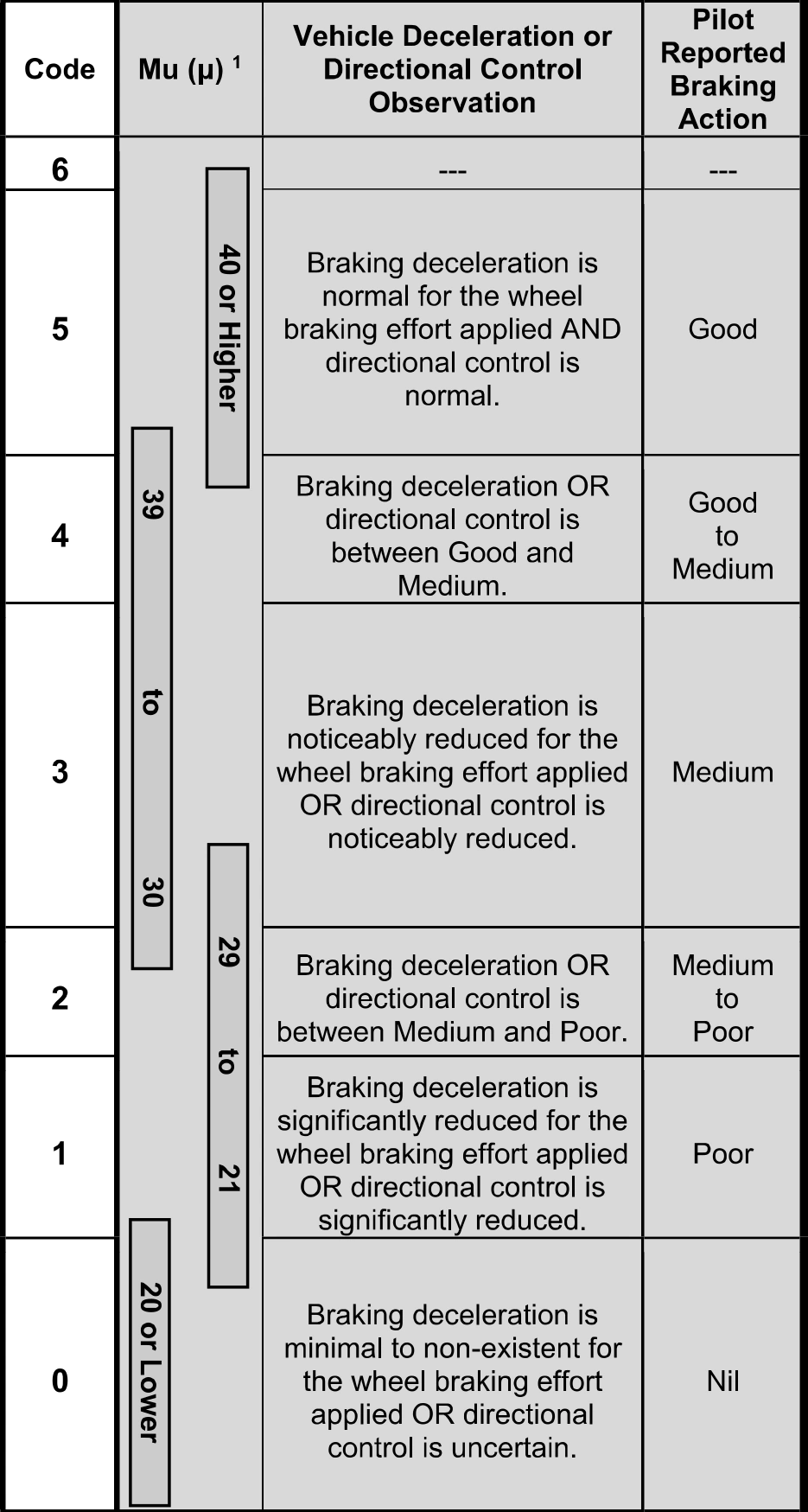
The FAA considers the RCAM to be the most objective method for condition assessments, and it considers pilot reports to be subjective. What the airport does with your statement can depend on that airports particular rules, but here are some general guidelines from AC 150/5200-30.
Two consecutive reports of 'POOR', following earlier reports of GOOD or MEDIUM, suggest runway condition is deteriorating. A runway assessment should be performed.
A report of 'NIL' braking action prompts the operator to close the runway until an assessment can be performed.
At the very least, controllers are encouraged to share PIREPs with other arriving aircraft.
From the NTSB Preliminary Report
On 9/24/2025 an ERJ-145 overran runway 34 at Roanoke-Blacksburg Regional Airport KROA.
This wasn't the cause of the incident, but I want to highlight decision making regarding runway condition.
"The first officer (FO), pilot monitoring, suggested reviewing the landing performance details for a wet runway, or a runway condition code (RCC) of 5, but the captain declined due to the ATIS not reporting precipitation."
Something gave the first officer situational awareness for the potential of a wet runway. Their judgement turned out to be correct. It turned out the runway was wet when they landed.
On 11/11/2019, an ERJ-145 departed the side of runway 10L at Chicago O'Hare while landing due to reduced braking action and directional control.
Weather was observed as light snow, with 2 inches of snow already on the ground, a crosswind of 18 to 28kts, and LIFR ceilings and visibility.
"[At 0624, about 1 hour and 20 minutes before the accident] The southside snow coordinator stated that he issued a field condition notice to air mission (NOTAM) that reported runway 10L as runway condition code 5/5/5"
Over the next hour, here are some of the pilot reports:
"...the first airplane to land on runway 10L after it was reopened, reported that the braking was “poor.” "
"...braking action was “medium” but that, after the airplane reached A3, the braking action “went down to poor.” "
"...braking action “was pretty solid up to [taxiway] N3 and pretty poor after that.” "
"[a departing aircraft] ...reported, “takeoffs not a good idea slide sideways.” "
"...it gets really hard to hold the centerline after [taxiway N3] because of the crosswind.”
"...braking action was “maybe medium.” "
"...braking action was “poor.” "
Several of the aircraft waiting for departure requested other runways, or even decided to head back to gates. These crews had the benefit of listening to tower frequency and hearing the reports themselves.
Prior to the accident, one inbound crew decided to divert. Upon checking in at the final approach fix, they received a medium to poor braking report and made the decision to land elsewhere.
Back to our accident aircraft...
"at 0739:34, the first officer notified the tower controller that the flight had arrived at the final approach fix. About 2 seconds later, the tower controller stated that the “RCC [runway condition code] is 555 – braking medium to poor up to [taxiway] November 3 and poor past [that point].” The first officer acknowledged this information."
What is "RCC 555, braking medium to poor" supposed to mean? Looking at the RCAM table above, medium is equivalent to an RCC of 3 and poor with 1. Essentially, "RCCs are 5's, but they are also 3's and 1's". Or another way, "Braking action is good, and it is also medium to poor."
"After the accident, the captain stated that he did not recall hearing any braking reports other than 5/5/5, and the first officer recalled that the controller reported “good” braking action before taxiway N3 and “3” (medium) past taxiway N3."
Passing the final approach fix is a busy time in the flightdeck and there are callouts and configuration changes that need to be made to maintain a stable approach. It requires extra focus to hear, understand, and act upon the other advisories the controller may provide us. Consider the reinforcing effect of the first portion of the advisory confirming 5/5/5 stated in the NOTAM.
"At 0740:28, the controller cleared the flight to land and stated that the wind was from 360° at 17 knots with gusts to 24 knots. The first officer acknowledged the clearance."
The aircraft is now setup to land on the runway that might be an RCC of 5/5/5, but more likely some combination of 3s, 2s, and 1s, with a crosswind component of 17 gusting to 24kts.
For me, RCCs of 2 or 1, and braking action reports of poor, have a crosswind limitation of <10kts.
"[Slowing through 80kts] the airplane “experienced an uncommanded swerve” to the left near taxiway N1, which was about one-third of the way down the runway from the approach end... the captain commanded airplane nose right rudder. However, rudder effectiveness at slower airspeeds and with thrust reversers is reduced and the left turn was not arrested... The airplane subsequently slid off the runway at an airspeed of about 60 knots and onto the grass on the left side of the runway."
The report states pilot technique was correct and aircraft function was normal in order to validate the cause of the runway excursion as wind and runway conditions.
The NTSB report dives into more detail as to why the FICON was still published as 5/5/5 more than an hour after observation despite numerous pilot reports of mostly medium and poor, it's interesting, but I don't know how much difference it makes.
I believe the lesson from these two case studies is that FICON NOTAMs should not be treated methodically, they require skepticism.
While in some documents, the FAA says RCAM is the most objective method for condition assessments. I want to share this quote from AC 91-79B, 3.13.5.5:
Building a Mental Model of Risk. ...discriminate airport observations, aircraft observations, and cockpit observations ... braking action reports may offer a higher degree of confidence than RwyCCs. Similarly, onboard radar may offer a timelier picture of expected conditions than either braking action reports or RwyCCs.