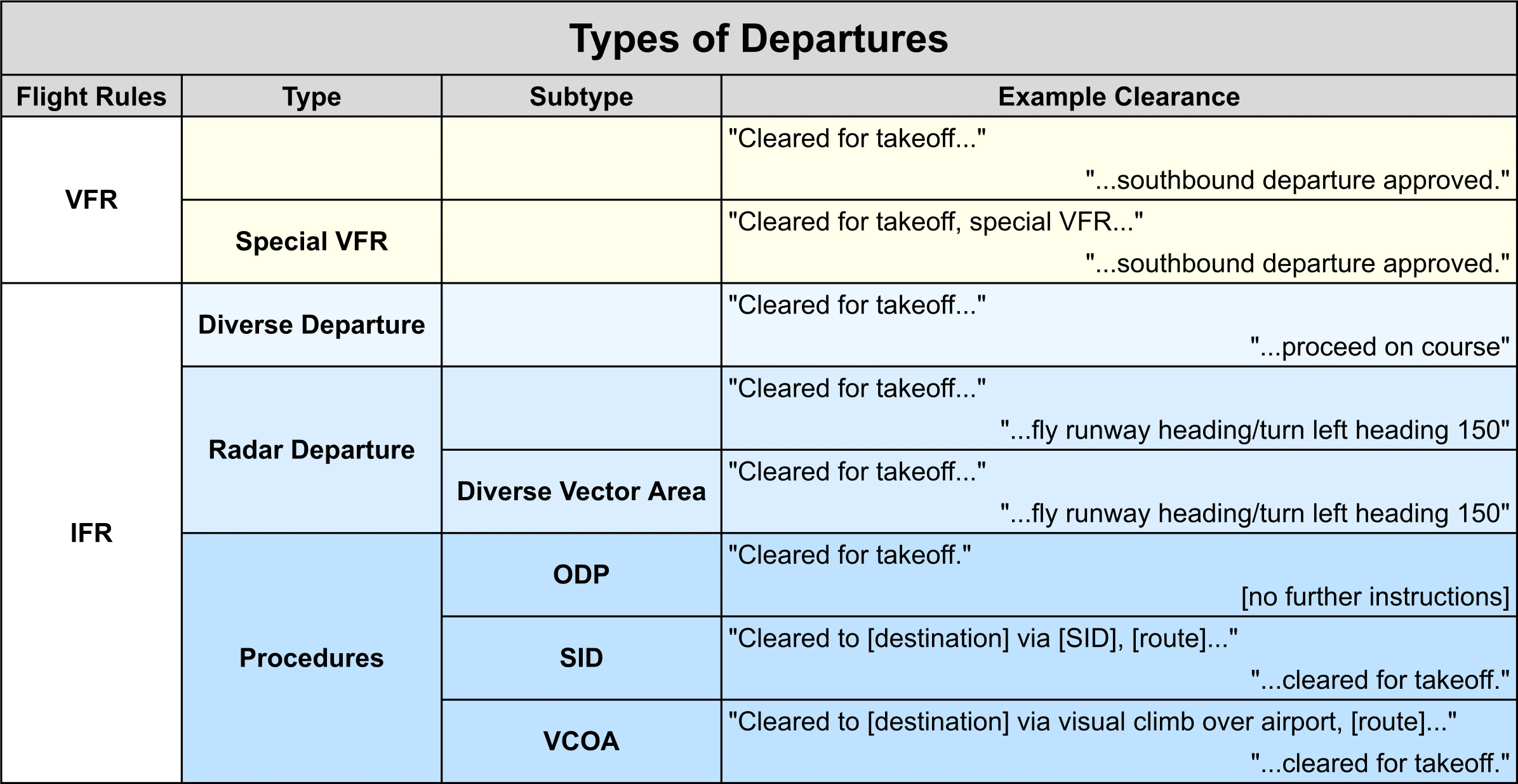
The following table lays out every type of departure that exists in the national airspace system.
At many airports, a VFR departure allows you to depart without interfering with IFR inbound traffic. Your IFR departure may be delayed until an inbound aircraft cancels. Your IFR departure might be forcing an inbound aircraft to hold until you clear the area.
Departing VFR requires we maintain our own obstruction avoidance, traffic separation, and VFR cloud clearance/visibility requirements. Upon receiving our IFR clearance, traffic separation is provided, flight into IMC is allowed, but we are still responsible for obstruction avoidance until reaching the minimum vectoring altitude (MVA) or enroute structure.
I have OpSpec C077, which discusses terminal VFR operations. Departure under VFR is permitted in certain conditions. The most limiting condition however is, "where it is not otherwise possible for the flightcrew to obtain an IFR clearance to depart on an IFR flight plan".
To me, this is a highly unlikely situation where we have no radio reception, my, the other pilot, the flight attendants, and the push tug operators cellphones are all dead.
Flying directly from the runway to the enroute structure is possible when there are no obstacles.
A diverse departure assessment is a conceptual takeoff where an aircraft is atleast 35' high by the departure end of the runway, flies runway heading until 400' above the departure end of the runway, and then turns in any and all directions, climbing atleast 200' per nautical mile. The applicable area generally extends to 25 nautical miles, but in mountainous areas is probably 46 nautical miles. As long as your performance is as good or better, obstruction clearance (with adequate margin) is provided.
ODPs are published solely for the purpose of obstruction clearance. Every airport that has an instrument approach is assessed for obstructions using the diverse departure test above. If the test fails, an ODP is published.
An ODP may be flown without ATC guidance unless an alternate procedure or radar vectors are assigned by ATC. It is best practice to advise ATC you intend to fly the ODP, rather than leave them guessing.
If departing an airport that passed the diverse departure assessment, you know that radar vectors provide obstacle clearance.
At airports with obstacles, a diverse vector area is established. Radar vectors within a diverse vector area provide obstruction clearance. ATC may be limited in what direction vectors are allowed and higher climb gradients may be required.
An example is Prescott, AZ (KPRC). Refer to FAA TERP section "TAKEOFF MINIMUMS..." L1, or the Jeppesen 10-9A chart. We see for most runways the procedure is "heading as assigned by ATC" but other runways have increased climb restrictions.
SIDs are designed by air traffic control to increase capacity in busy airspace. All SIDs provide obstruction clearance.
These procedures are uncommon, but they are their own distinct type of procedure, so I included them here for completion.